
Gynecomastia
Gynecomastia surgery gives the chest back a firm, masculine shape. Liposuction combined with gland removal, a natural result and minimal scars.
Gynecomastia surgery removes an enlarged breast gland in men and gives the chest back a firm, masculine and flat appearance. The condition affects 35–70% of men at some point in their lives — most often in puberty, in middle age or as a result of medication, steroids, hormonal imbalance or excess weight. The enlarged gland creates “female” breasts, which many men see as an aesthetic and emotional problem that holds them back in sport, in fitted clothes, on the beach or in intimate situations.
Who the procedure is for
Gynecomastia surgery is best suited to men with the true glandular form — firm, palpable tissue under the nipple that forms a hard “button” or a flatter swelling. We often also see a combined form, with both an enlarged gland and a more pronounced fatty component in the chest. The best and most stable results are achieved in men of normal or only slightly increased weight who have kept a stable weight for at least 6–12 months and have no serious illnesses.
If the problem is mainly fat (so-called pseudogynecomastia), caused mostly by excess weight or hormonal changes without a significant glandular component, tumescent liposuction alone is often enough — a quick, less invasive procedure with minimal scars. Most men, however, have a combined form, where fat is only part of the problem and the glandular tissue has to be removed surgically; otherwise a hardened lump under the nipple or an uneven chest would remain after liposuction. A combined approach (liposuction + subcutaneous mastectomy) therefore gives the best aesthetic result: a flat, firm, masculine chest with no visible traces.
Men with significant excess weight or an unstable weight should first stabilise their weight — further weight loss after the operation could lead to sagging skin or unevenness. If gynecomastia is caused by medication, steroids or a hormonal disorder, we recommend seeing an endocrinologist first to rule out or treat the underlying cause.
What the chest looks like after gynecomastia surgery
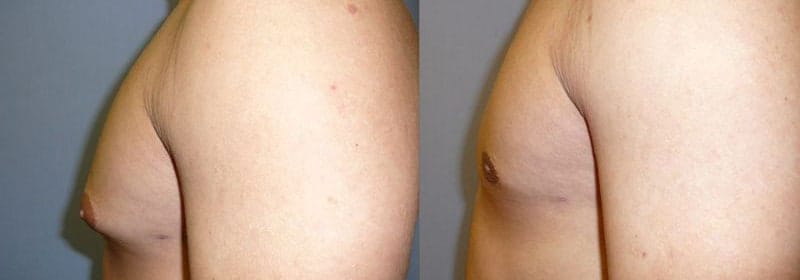
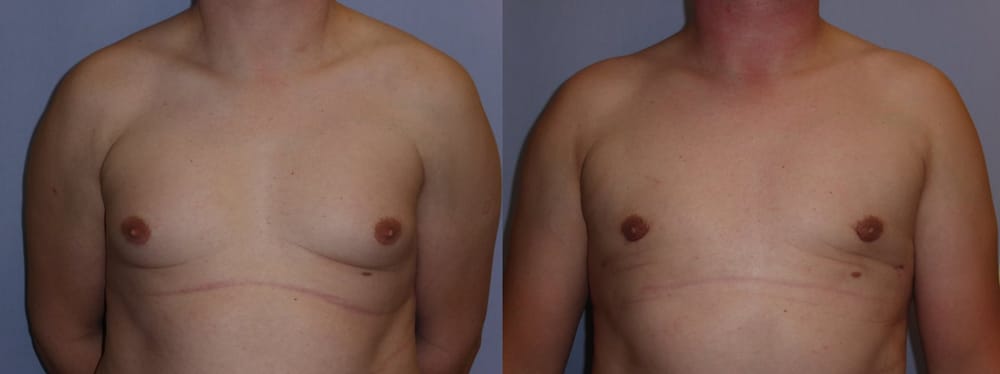
After successful gynecomastia surgery the chest has a firm, flat and masculine appearance. Immediately after the operation (the first 1–2 weeks) the chest is still slightly swollen and bruised and feels tight because of the compression vest and healing. This is normal and passes quickly.
Once the vest comes off (usually after 4 weeks), the real result starts to show:
- The chest is smooth, flat and symmetrical — no “buttons”, hardened lumps or sagging tissue under the nipples
- The area under the nipple is firm and flat, with no noticeable bulge
- The transitions to the armpits and sides are smooth, without “steps” or unevenness
- The skin gradually adapts to the new shape and adheres to the chest wall
- The scars are very small (usually just a thin line around the areola or a small one in the armpit) and after 6–12 months fade and flatten so much that they are almost invisible
The final result settles after 3–6 months, when the swelling has fully subsided and the skin has fully adapted. For the vast majority of patients the change is so natural that nobody around them can tell they have had surgery.
How gynecomastia surgery is performed
The procedure is performed under general anaesthesia and usually takes 1–2 hours. Most often we use a periareolar approach — a small incision around the areola that remains almost invisible once healed. First, tumescent liposuction reduces the fatty component of the chest to create a flat base. This is followed by a subcutaneous mastectomy — the careful removal of the enlarged breast gland. The wounds are closed with absorbable stitches and finally an elastic compression garment is put on, which must be worn continuously for 4 weeks. Compression minimises bleeding, swelling and unevenness and helps the skin adhere better to the new shape of the chest.
Recovery
Recovery is relatively quick — in the first week we recommend rest, wearing the compression vest and limiting arm movement. Swelling and bruising gradually fade within 1–2 weeks. After 10–14 days most men return to their normal routine (lighter work, driving). Full physical activity is possible after 4–6 weeks. The scars around the areola improve over 6–12 months and remain very discreet.
Consultation
Send us a message and we usually reply within one working day.