Skin Rejuvenation and Regeneration
Sunken cheeks
Sunken cheeks are among the common signs of facial ageing, yet people talk about them less than abou...
Hyaluronic acid-based fillers rank among the most popular procedures in aesthetic medicine because they offer a natural look and a predictable result. Occasionally, however, a situation arises when the effect of the filler needs to be reduced or completely removed. The solution is the enzymatic dissolution of hyaluronic acid.
Dissolving hyaluronic acid is a procedure in which the enzyme hyaluronidase is injected into the treated area. It is a substance that occurs naturally in the body, primarily in connective tissues, skin and cartilage. It is used in medicine mainly to improve the absorption and dispersion of other drugs; in aesthetic medicine it is used to dissolve hyaluronic acid fillers. It breaks down the molecules of hyaluronic acid so that the filler is absorbed very quickly.
Hyaluronidase acts specifically on hyaluronic acid. That is why this method is a safe and predictable way to adjust or completely remove the result of a previous filler.
Dissolving hyaluronic acid is most often required in cases of dissatisfaction with the result, uneven distribution of the filler or so-called migration of the material into the surrounding tissue. The procedure is also necessary in the rare event of a vascular complication, when the filler restricts the blood supply to the tissue.
Typical reasons for dissolving are:
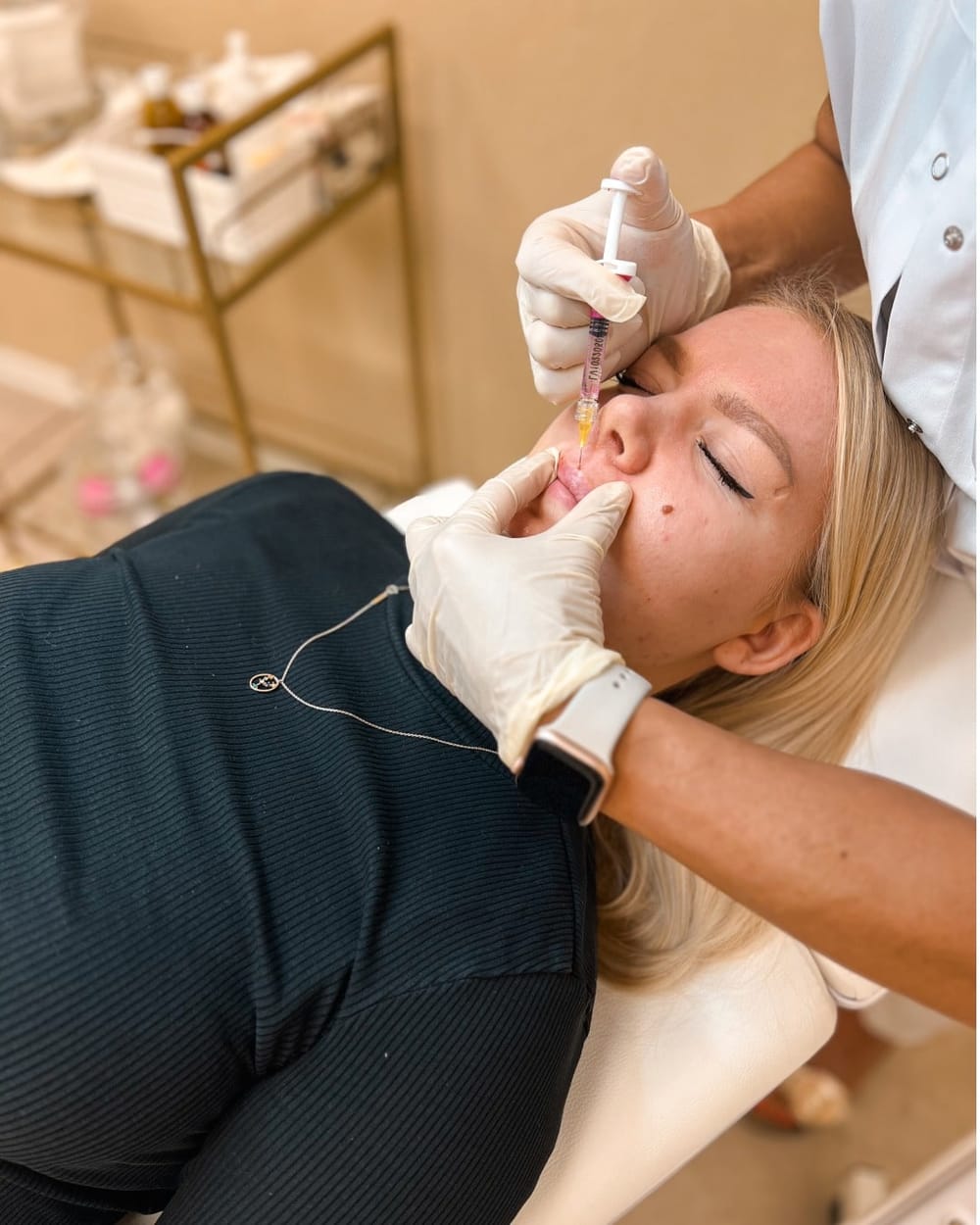
The procedure takes the form of several small injections of hyaluronidase directly into the treated area. The enzyme is dosed according to the amount of filler and the desired result.
Before application the doctor examines the treated area and determines how much enzyme is needed to achieve the desired effect. For more extensive corrections the procedure is performed in several sessions with a time interval so that the result can be continuously monitored and the dosage precisely determined.
The effect of hyaluronidase sets in very quickly; a visible reduction in volume is noticeable within a few minutes to hours after the procedure. The full effect is assessed after several days.
At the injection site mild swelling or redness may appear, which usually subsides within one to two days. Recovery is minimal and clients generally return to their normal routine immediately after the procedure.
A new filler can be applied once the enzyme hyaluronidase is no longer present in the tissues. We usually recommend waiting at least two weeks after the procedure before a new filler. An earlier application could affect the result, because residual enzyme would also break down the newly applied hyaluronic acid.
The exact interval is always determined by the treating physician according to the amount of enzyme administered and the individual tissue response. We therefore recommend scheduling a new application only after a consultation.

Whether you are dealing with dissatisfaction with the volume, an uneven result or an acute complication, hyaluronidase can safely correct the situation within minutes to days.
The advantage of hyaluronic acid fillers is their reversibility. Unlike many other procedures in aesthetic medicine, hyaluronic acid gives clients the assurance that even an unsatisfactory result can be quickly and safely corrected. It is precisely this possibility that makes hyaluronic acid-based fillers one of the least risky ways to adjust appearance without fear of irreversibility.
The key to a good result is an experienced doctor who adapts the dosage and further procedure precisely to your needs. Equally important is open communication before the procedure: the more precisely you describe what bothers you about the current result, the better the doctor can choose the right amount of enzyme and the application technique. If you are considering dissolving hyaluronic acid, the first step is certainly a consultation at which we will jointly plan a procedure tailored exactly to your needs.
The procedure is well tolerated; it consists of small injections with a thin needle into the treated area. More sensitive places, such as the lips, are numbed before the procedure with a topically applied ointment or solution containing a local anaesthetic.
The first visible reduction in volume is noticeable just a few minutes after the procedure; the full effect stabilises within a few days.
The degree of dissolution is determined by the doctor through the dosage of the enzyme according to the desired result. It is thus possible to remove the filler completely or only to reduce its volume and adjust the shape.
Yes, hyaluronidase breaks down hyaluronic acid regardless of how long it has been present in the tissue.
Dissolving hyaluronic acid performed by a qualified doctor ranks among the safe procedures of aesthetic medicine.
Hyaluronidase may rarely trigger an allergic reaction; clients with a history of especially polyvalent or strong allergic reactions to other allergens are provided with a preventive dose of corticosteroids.
Sunken cheeks are among the common signs of facial ageing, yet people talk about them less than abou...
Lip correction is one of the most popular procedures in aesthetic medicine. It allows the shape, volume and contour of the lips to be adjusted so that they look fuller, more...
Facial slimming can be achieved without surgery. The most effective method is the application of BTX to the masseter muscle, which reduces its volume and visually slims the...
Send us a message and we usually reply within one working day. Consultations are free.