
Body care
Gift vouchers for aesthetic treatments – Christmas ideas by budget
Christmas is a time of joy and wishes come true – and a gift that keeps giving long after it is unwrapped is a little self-care...
Breast cancer is the most common malignant tumour in women in the Czech Republic. It cannot be prevented entirely, but detecting it early significantly increases the chance of successful treatment. In this article you will learn what you can do for the health of your breasts yourself – how to examine your breasts properly, which changes to look out for and why a regular ultrasound makes sense at any age. How the breast ultrasound in Pilsen itself works and how to book it is described on the examination page.
Breast cancer can affect women of any age and, rarely, men too. A small lesion that is not yet causing any problems can be treated more gently and with a better prognosis – which is why the earlier a change is found, the better. Prevention does not rest on a single examination but on a combination of three things: regular self-examination, a healthy lifestyle and preventive check-ups with a doctor.
Most changes a woman feels in her breast or that an ultrasound picks up are benign – for example fluid-filled cysts or fibroadenomas, which often only need monitoring. A regular check-up is therefore no reason to be afraid but a way to keep your health under control and gain peace of mind.
Some women have a higher risk of breast cancer than others. You should be particularly attentive in these cases:
A higher risk does not mean you will fall ill – it simply makes regular prevention all the more important for you. Agree with your doctor when to start check-ups and how often to repeat them.
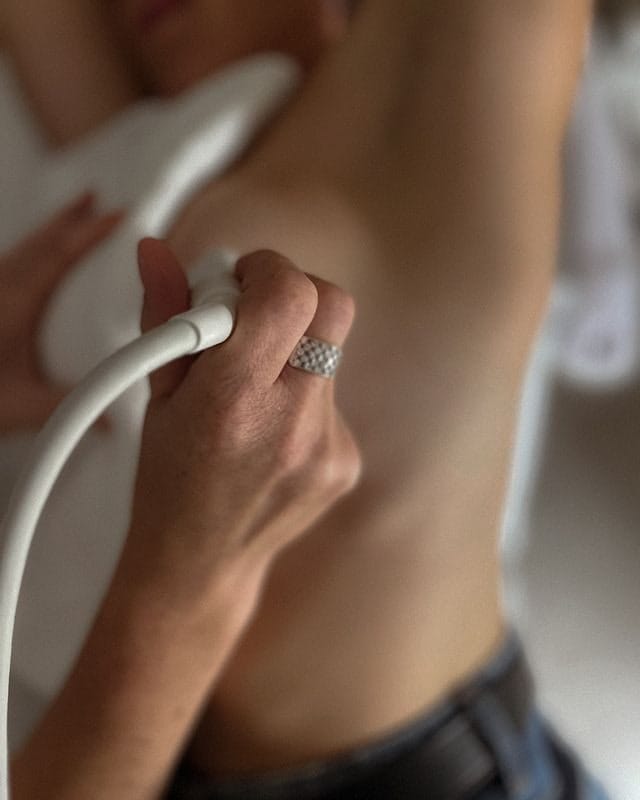
Self-examination takes only a few minutes and helps you get to know how your own breasts look and feel – so you will recognise any change more easily. Ideally, do it once a month, a few days after your period ends, when the breast glands are hormonally calm. Women after the menopause can choose any fixed day of the month.
Self-examination does not replace a medical check-up – an ultrasound can detect even small lesions that cannot yet be felt. It is, however, a valuable addition that keeps you in touch with your body between visits to the doctor.
Book an examination as soon as possible if you notice:
Most such changes turn out to be benign, but only an examination can give you certainty. This applies to men too – breast cancer is far less common in men, but they should still not ignore a lump in the breast.
Ultrasound is a safe and non-invasive method that does not use X-rays, so it can be repeated without putting any strain on the body. It can distinguish a fluid-filled cyst from a solid lump and detect even small changes that cannot yet be felt. That makes it suitable as a regular preventive check-up even for women who have no symptoms.
We recommend a preventive breast ultrasound once a year from the age of 30, and earlier if there is breast cancer in the family. If your risk is higher or after a previous finding, the doctor may suggest more frequent checks.

It is never too early or too late for prevention – what changes over the course of your life is which examination suits you best:
You will find a detailed comparison of the two methods in our article ultrasound vs. mammography.
Some risk factors, such as genetics or age, are beyond your control. Others, however, you can work on: regular exercise, maintaining a healthy weight, limiting alcohol and not smoking are among the general recommendations that benefit your breasts and your whole body. It is just as important not to skip preventive check-ups and to tell your doctor about any cancer in your family.
Once a year from the age of 30 – if there has been breast cancer in your family, it is a good idea to start earlier. Your doctor will recommend the right interval for you based on your risks.
No. Self-examination helps you notice changes between visits to the doctor, but small lesions that cannot yet be felt can only be detected by an examination such as ultrasound.
Don’t panic, but don’t put it off either. Most lumps are benign, for example cysts or fibroadenomas. Book an examination as soon as possible so that the situation can be assessed and the next steps suggested.
Yes. A preventive ultrasound is intended precisely for women with no symptoms and gives you the reassurance that your breast tissue is fine.
Yes. It does not use X-rays, so it is suitable for women of all ages, including pregnant and breastfeeding women.
Yes, although far less often than women. If a man feels a lump or swelling in his breast, he should have it examined too.
Breast cancer prevention rests on simple steps: know your breasts, notice changes, live healthily and don’t forget regular check-ups. At Hello Beauty Clinic in Pilsen you can book a breast ultrasound without a referral, and you will be examined by radiologists from Pilsen University Hospital.
Christmas is a time of joy and wishes come true – and a gift that keeps giving long after it is unwrapped is a little self-care...
Most lumps under the skin are benign, but their nature cannot always be reliably determined by touch...
Ultrasound examination is one of the safest and most accessible diagnostic methods in modern medicine. It does not burden the body with radiation, it is painless and you know...